When people first discover tax lien investing, they often focus on one thing: how much interest they can earn.
While potential returns are certainly important, experienced investors understand that building wealth involves more than finding a single attractive investment. It requires a strategy for managing capital, spreading risk, and creating a portfolio that can grow over time.
One of the most important principles in tax lien investing is diversification.
Rather than committing all available investment capital to one tax lien certificate, investors can explore opportunities across different properties, counties, and auction cycles. This approach can help reduce exposure to individual investment problems while creating a more structured path toward long-term portfolio development.
Whether you’re starting with a few hundred dollars or have a larger amount available, understanding how to build a tax lien portfolio is an important step toward investing with greater confidence.
Why Diversification Matters in Tax Lien Investing
Every investment carries some degree of uncertainty, and tax liens are no exception.
A property may have unexpected title complications, a redemption period may last longer than anticipated, or an investor may discover that the underlying property has limited market value.
When all your capital is committed to one lien, a problem with that investment can have a significant impact on your overall results.
Diversification helps address this concern by spreading investment exposure across multiple opportunities.
For example, instead of purchasing one $5,000 tax lien, an investor might consider allocating that capital among several smaller liens, provided each opportunity passes the necessary due diligence.
The objective isn’t simply to own more certificates. It’s to avoid having the outcome of your entire investment strategy depend on a single property.
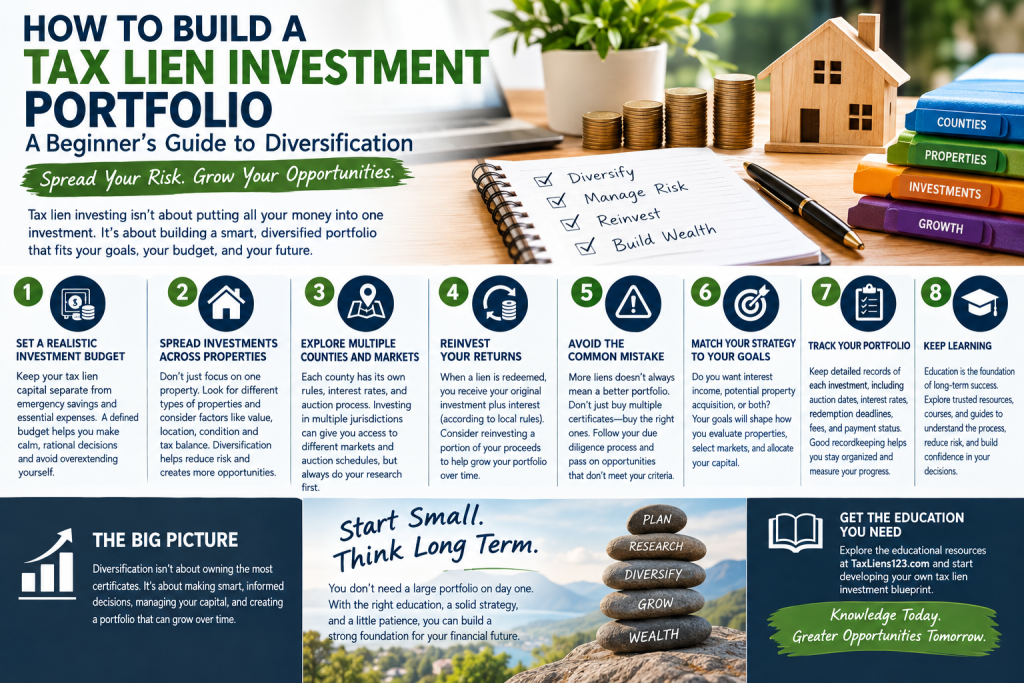
Start With a Clearly Defined Investment Budget
Before purchasing your first tax lien, determine how much capital you can comfortably allocate to the strategy.
Your investment budget should be separate from emergency savings, household expenses, and money needed for other financial obligations.
Tax lien investments can remain tied up for extended periods, depending on redemption timelines and local procedures. Consequently, investors should avoid assuming that their capital will always be immediately available.
A defined budget provides a foundation for making rational decisions rather than reacting emotionally to attractive auction opportunities.
It also helps establish a maximum investment amount for each individual lien.
Consider Spreading Investments Across Multiple Properties
One of the simplest ways to begin diversifying is by investing in multiple properties rather than concentrating your entire budget in one location.
Different properties have different characteristics, including:
- Estimated market value
- Property type and condition
- Geographic location
- Outstanding tax balances
- Potential marketability
- Legal and title considerations
Evaluating these factors can help investors identify opportunities that fit their individual criteria.
However, owning multiple liens does not automatically eliminate risk. Several investments in the same neighborhood or exposed to similar market conditions may still experience related problems.
The purpose of diversification is to manage exposure thoughtfully, not to guarantee positive results.
Explore Different Counties and Markets
Tax lien investing is governed by state and local laws, and the rules can vary considerably.
Interest rates, redemption periods, bidding procedures, and foreclosure requirements may differ between jurisdictions.
For this reason, some investors explore opportunities in multiple counties over time.
Expanding geographically can provide access to different property markets and auction schedules, but it also introduces additional research requirements.
Before investing outside your familiar area, understand the applicable regulations, auction procedures, property records, and investor obligations.
A smaller portfolio in markets you understand may be more manageable than a larger portfolio spread across jurisdictions you have not properly researched.
Reinvesting Returns: A Potential Path to Portfolio Growth
One appealing aspect of tax lien investing is the possibility of reinvesting proceeds from redeemed certificates.
When a property owner pays the outstanding taxes, interest, and applicable fees, the investor receives payment according to the governing rules.
Rather than immediately withdrawing all proceeds, some investors choose to allocate a portion toward additional certificates.
Over multiple investment cycles, reinvestment may help increase the amount of capital available for future opportunities.
Consider a simplified example:
An investor begins with $3,000 in available capital and gradually reinvests proceeds from redeemed liens. As additional capital becomes available, the investor can evaluate more opportunities without necessarily contributing the same amount of new money each time.
Actual growth depends on redemption timing, interest rates, expenses, taxes, and investment outcomes. Returns are not guaranteed, and capital may remain tied up longer than expected.
Nevertheless, a disciplined reinvestment plan can be an important part of a long-term investment strategy.
Don’t Confuse Diversification With Buying Everything
A common beginner mistake is assuming that more tax liens automatically mean a better portfolio.
In reality, purchasing several poorly researched certificates can create more problems than owning one carefully evaluated investment.
Every lien should pass your established due diligence process.
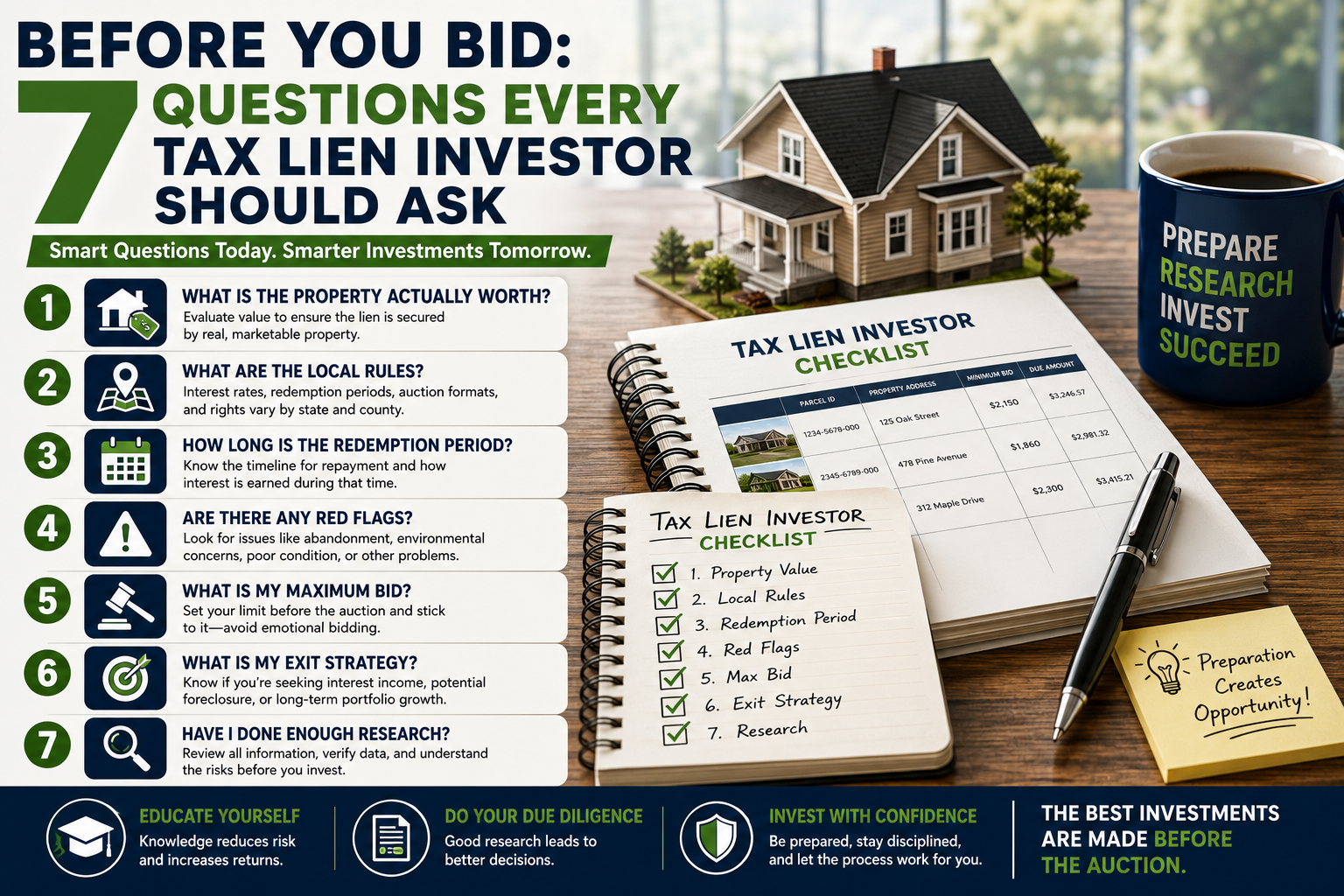
Before bidding, consider:
- Is the property reasonably valued?
- Have I checked available ownership and title information?
- Are there potential senior liens or other legal complications?
- Do I understand the applicable redemption period?
- Is the investment consistent with my maximum bid?
- Can I afford to have this capital committed for the expected timeframe?
If an opportunity doesn’t meet your criteria, passing on it is a perfectly reasonable investment decision.
The goal is to build a portfolio of researched opportunities, not simply accumulate certificates.
Create a Strategy for Different Investment Goals
Not every tax lien investor has the same objective.
Some prioritize interest income and prefer to focus on certificates they expect to be redeemed.
Others are interested in potential property acquisition through legally required foreclosure procedures.
Still others want a combination of both approaches.
Your investment objectives should influence how you evaluate properties, select markets, and allocate available capital.
Importantly, foreclosure should never be treated as an automatic outcome. It involves legal procedures, additional costs, and jurisdiction-specific requirements, and may not result in acquiring a property.
Understanding your intended exit strategy before bidding can help prevent costly misunderstandings.
Track Your Portfolio Like a Professional
As your number of investments increases, organization becomes increasingly important.
Maintain a record of every certificate, including:
- County and property identification
- Original investment amount
- Auction date
- Applicable interest rate
- Redemption deadline
- Additional expenses
- Payment and redemption status
- Important legal or administrative dates
A spreadsheet or dedicated portfolio tracking system can help you monitor your investments and identify upcoming obligations.
Good recordkeeping also makes it easier to evaluate your actual performance rather than relying on advertised interest rates alone.
Education Is the Foundation of Portfolio Growth
Building a tax lien portfolio is a process. It requires patience, research, and a willingness to learn from each investment cycle.
Understanding the rules of your target markets, analyzing properties, managing capital, and maintaining consistent records can help you approach the process systematically.
This is precisely why structured education can be valuable before committing significant funds.
At TaxLiens123.com, investors can explore educational resources designed to explain tax lien investing from the ground up.
From introductory lessons to comprehensive courses and updated ePrint learning materials, the goal is to help individuals understand the process, evaluate opportunities, and develop their own investment strategies.
Start Small. Think Long Term.
You don’t need to build a large portfolio overnight.
Beginning with a manageable investment budget allows you to learn how auctions operate, understand redemption procedures, and develop a repeatable research process.
As your experience grows, you can reassess your strategy, explore additional markets, and determine whether expanding your portfolio fits your financial objectives.
Tax lien investing isn’t about purchasing the greatest number of certificates or chasing the highest advertised interest rate.
It’s about making informed decisions, managing capital responsibly, and understanding the opportunities and risks associated with every investment.
The foundation of a successful investment strategy isn’t how much you invest on day one. It’s how thoughtfully you approach every decision that follows.
Explore the educational resources at TaxLiens123.com and begin developing your own tax lien investment blueprint.