By now, you’ve seen that tax lien investing isn’t reserved for institutions or full-time real estate professionals. You don’t need to own rental properties, manage tenants, or take on large mortgages to participate. You also know that education is more accessible than ever—whether online, over the phone, by email, or even through printed materials.
But there’s one factor that consistently separates successful tax lien investors from everyone else: preparation.
While many newcomers are drawn in by the potential for double-digit returns or the idea of acquiring property at a fraction of its value, seasoned investors understand that those outcomes don’t happen by accident. They’re the result of a disciplined, repeatable process that starts long before auction day.
The Difference Between Guessing and Investing
At first glance, a tax lien auction can seem straightforward. You review a list, choose a property, place a bid, and hope for the best.
That approach might work occasionally—but it’s not a strategy.
Preparation transforms tax lien investing from a gamble into a calculated decision. Instead of reacting in the moment, you’re working from a clear plan built on research, criteria, and defined goals.
Prepared investors don’t just ask, “What can I win?”
They ask, “What should I avoid?” and “Does this fit my strategy?”
That shift in mindset is where real progress begins.
What Smart Preparation Actually Looks Like
Preparation doesn’t mean overcomplicating things. In fact, the best investors rely on simple systems they can repeat consistently.
It starts with understanding the auction environment. Is it bid-down interest, premium bidding, or a random selection process? Each format changes how you approach your bids and calculate potential returns.
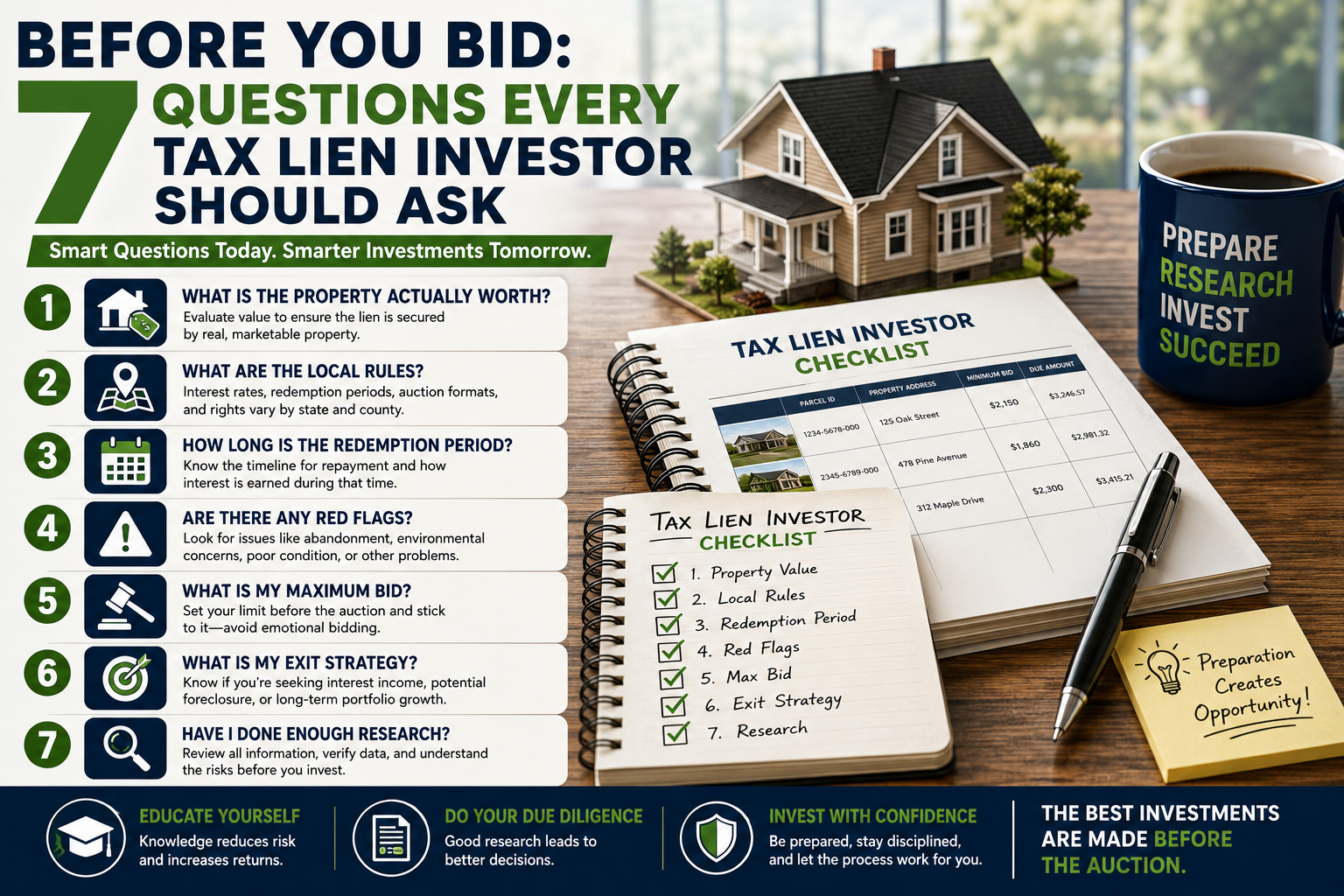
Next comes property-level research. Even though you’re not buying the property outright (at least initially), the property still matters—it’s your collateral. That means looking at estimated value, location, and any obvious red flags that could impact your investment.
Then there’s the legal and structural side. Are there other liens that could take priority? What are the redemption timelines? What happens if the lien isn’t redeemed?
These aren’t advanced tactics—they’re foundational steps. And skipping them is where many beginners run into trouble.
Building a Repeatable System
One of the biggest advantages in tax lien investing is the ability to create a process you can reuse.
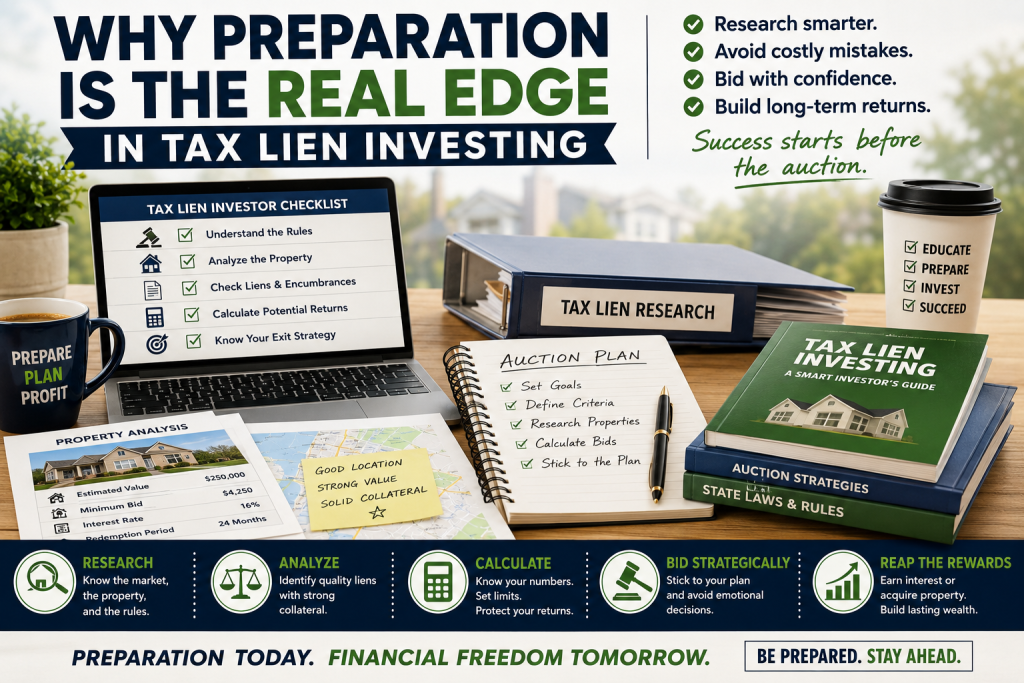
Instead of starting from scratch each time, you develop a checklist:
- Minimum property value thresholds
- Target interest rates or bidding limits
- Geographic areas you understand or can research effectively
- Clear exit expectations (interest income vs. potential foreclosure)
With a system in place, decisions become faster and more consistent. You’re no longer relying on instinct or emotion—you’re following a framework that keeps you aligned with your goals.
Over time, this consistency compounds. You refine your criteria, improve your research speed, and become more selective about the liens you pursue.
Avoiding the Most Common Pitfalls
Many of the risks in tax lien investing don’t come from the strategy itself—they come from lack of preparation.
Overbidding is one of the most common mistakes. In competitive auctions, it’s easy to get caught up in the moment and accept lower returns than planned.
Another issue is ignoring property quality. Not all liens are created equal. A lien on a well-located residential property is very different from one tied to unusable land or a deteriorated structure.
There’s also the challenge of incomplete research. Missing a key detail—like a superior lien or zoning issue—can turn what looked like a solid investment into a complicated situation.
Preparation doesn’t eliminate risk, but it dramatically reduces avoidable mistakes.
Confidence Comes From Clarity
A well-prepared investor approaches auctions differently. There’s less hesitation, less second-guessing, and far less stress.
Why? Because the decisions have already been made in advance.
You know your limits.
You know your criteria.
You know what fits—and what doesn’t.
That clarity allows you to act decisively when opportunities appear, instead of scrambling to figure things out in real time.
Turning Knowledge Into Action
At some point, preparation has to lead to action. The goal isn’t to research endlessly—it’s to build enough understanding and structure to participate with confidence.
Start small. Test your process. Learn from each experience.
With every auction cycle, you’ll gain insight that no course or guide can fully replicate. But that experience becomes far more valuable when it’s built on a solid foundation of preparation.
The Real Opportunity Behind Tax Liens
Tax lien investing isn’t just about returns—it’s about control. You’re choosing your level of involvement, your markets, and your strategy.
Preparation is what makes that control possible.
It’s what allows you to move from curiosity to capability, from uncertainty to informed decision-making.
And in a space where many people are still trying to figure things out on the fly, being prepared isn’t just helpful—it’s a genuine competitive advantage.
If you’re serious about making tax lien investing part of your financial strategy, don’t rush to the auction. Take the time to prepare, build your system, and understand the process.
Because in the long run, it’s not the fastest investor who wins—it’s the one who’s ready.